


HIFU Results: What Really Happens After Your Treatment?

One of the biggest misconceptions about HIFU is that results should appear overnight.
In reality, HIFU works very differently from treatments that create an instant cosmetic change.
Rather than adding volume or temporarily altering facial movement, HIFU stimulates your body's own regenerative processes deep beneath the skin.
The treatment creates precise thermal coagulation points within the dermis and deeper support structures, triggering a healing response known as neocollagenesis — the production of new collagen, elastin and supportive tissue.
This process takes time.
Understanding the timeline helps explain why patience is one of the most important parts of successful HIFU treatment.
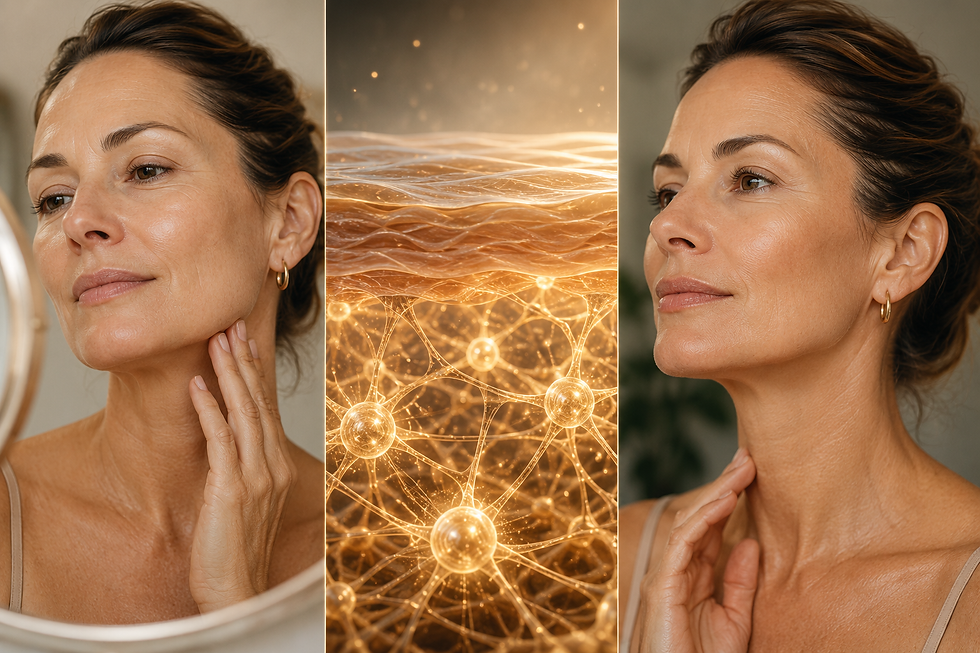
The 3-Phase HIFU Cycle
Phase 1: The Flash Effect (Immediately After Treatment)
Many clients leave their appointment noticing that their skin feels tighter and their facial contours appear slightly more lifted.
This is often called the "Flash Effect."
At this stage, approximately 20% of the final result may be visible.
This early improvement is caused by:
• Immediate collagen contraction
• Tissue tightening
• Mild treatment-related swelling
• Temporary tissue compression
Many people assume this is their final result.
It isn't.
Over the following days some of this initial tightening may soften as inflammation settles and the tissues return to normal.
This is completely expected and does not mean the treatment hasn't worked.
The real transformation is only just beginning.
Phase 2: Cellular Awakening (Days 21–30)
Around three to four weeks after treatment, fibroblasts become highly active.
Fibroblasts are specialised cells responsible for producing:
• Collagen
• Elastin
• Hyaluronic acid
This stage marks the beginning of true tissue regeneration.
Clients often notice:
✓ Brighter skin
✓ Improved texture
✓ Better hydration
✓ Increased skin density
✓ A healthier complexion
At this stage many clients start receiving compliments without people necessarily knowing why they look fresher.
The changes are subtle, natural and progressive.
Phase 3: Full Collagen Remodelling (2–6 Months)
This is where the most significant improvements occur.
New collagen fibres gradually mature and reorganise into stronger, thicker support structures.
The extracellular matrix — the framework that supports the skin — becomes denser and more organised.
This process produces:
✓ Improved jawline definition
✓ Firmer cheeks
✓ Better neck support
✓ Reduced skin laxity
✓ Improved facial contours
✓ Long-lasting tightening
For many clients the most noticeable improvements occur between months two and six.
This is why comparing photographs taken several months apart often reveals far more
improvement than daily mirror checks.
How Many HIFU Treatments Will I Need?
There is no universal answer.
Every face ages differently.
Factors such as genetics, lifestyle, collagen quality, smoking history, sun exposure and tissue weight all influence treatment planning.
Mild to Moderate Laxity (Typically Ages 30–45)
For clients with early signs of ageing, one treatment is often sufficient to stimulate significant collagen renewal.
A maintenance session may be considered every 12–18 months depending on individual ageing patterns.
Advanced Laxity or Heavier Tissue (Typically Ages 45–65+)
When laxity is more established, a staged treatment approach may be beneficial.
In some cases, an initial protocol of two or three treatments may be recommended.
However, timing matters.
Treatments should never be performed too close together.
The body requires time to complete the collagen-building process.
Performing additional sessions too early may interrupt natural healing and remodelling.
For this reason treatments are typically spaced:
• Minimum 30–45 days apart
• Ideally 60 days apart
Once the desired result has been achieved, maintenance is often recommended every 8–12 months.
Why Combining Treatments Often Produces Better Results
Facial ageing is not a single-layer problem.
The skin surface changes.
Collagen declines.
Muscles lose support.
Lymphatic drainage slows.
Fat compartments shift.
Because of this, modern facial rejuvenation often combines complementary therapies.
HIFU + Radio Frequency
One of my favourite combinations.
HIFU works deep within the tissue, stimulating structural support and tightening.
Radio Frequency works more superficially, improving:
• Skin texture
• Skin quality
• Pore appearance
• Surface firmness
• Overall skin glow
Think of it this way:
HIFU creates the foundation.
Radio Frequency refines the finish.
HIFU + Microneedling
Once deeper collagen stimulation has begun, microneedling can further support skin quality and regeneration.
This combination may improve:
• Fine lines
• Texture
• Scarring
• Skin brightness
• Product absorption
HIFU + Lymphatic Support
Many clients also benefit from lymphatic techniques such as facial massage, cupping or drainage-focused treatments.
Healthy circulation and lymphatic movement support tissue recovery and help maintain healthy-looking skin.
Natural Regeneration Takes Time
The best HIFU results are rarely immediate.
They develop gradually.
This is one of the reasons many clients love the treatment.
Friends and family often notice they look fresher, healthier and more lifted without being able to identify exactly why.
The goal isn't to change your face.
The goal is to support the structures beneath it.
By working with your body's own regenerative processes, HIFU encourages firmer, stronger and healthier skin over time.
Considering HIFU?
Every face is unique.
At Pure Aesthetics, every treatment begins with a consultation to assess skin quality, facial structure and areas of concern before creating a personalised treatment plan.
📍 Pure AestheticsMatthew Curtis Hair Design1 Union StreetStratford-upon-Avon
Book a consultation to find out whether HIFU may be suitable for you.


Comments